Monday, March 14, 2016

Mora Growers' Coop Seed and Story Exchange

Mora Valley from Holman Hill

It was one of those early spring days that are so distinctly New Mexican. The sky clear and bright, slight breeze blowing clouds of juniper pollen and early spring runoff from the snow packed mountains filling the dry arroyos. A time of renewal and a time to come together to share seeds, our stories and our hopes for the coming growing season.
The Mora Valley has a deep rooted history of traditional agricultural practices.  At one point in the 1930's there were over two hundred varieties of wheat growing in the Mora Valley and three hundred flour mills.  This was also the time of the great depression an\ wheat prices plummeted which had a major impact on the survival of the mills and the small Mora Valley farms. Tragically most of the mills closed down apart from the Cleveland Mill which continues to hold this important agricultural history as it is now a state museum.
The memory of this poignant time in the Mora Valley has been brought alive in the many small farms that are reemerging in this vibrant community. At the helm of this revival has been the Los de Mora Growers' Cooperative   which encourages a community driven support system for the local small farmer. Three years ago when SeedBroadcast attended the first seed exchange in Mora we met with Roger Gonzales who shared with us his dream of reestablishing a traditional agricultural economic base for the valley.  This dream is now a reality and is activating the resurgence of new small farms in the area. Roger is a local grower and seed saver and has a variety of calabacitas that has been in his family for generations. Listen to Roger's story here:


This year's community seed exchange was held in the St Gertrude's Credit Union building where a  hand painted sign states  "Where saving makes cents".  There was a celebratory atmosphere in the air as people showed up to mark the coming of spring with their seeds, wisdom and pots of food to share.


The day started with a sharing of seeds and stories from last years crops and the hopes for the coming year.  Local church deacon Eloy Roybal shared his dreams of bringing back the local wheat on his land that has been in his family for generations. He had come to the exchange with the expectation to find some wheat to plant, others came just to see if they could find a new variety of seed and others seeking advise on local growing practices.   After a pot luck lunch Roger Gonzales led an afternoon of practical training touching upon best growing practices for the region, the economics of running a small farm,  the advantages of hoop houses,  how to deal with pests such as slugs and grasshoppers and the importance of keeping a crop journal.   This "training" was more like a community round table conversation with everyone freely sharing their own experiences, demonstrating the importance of learning from the local farmer's knowledge.


This years event was coordinated by Anita Moss, a board member of the Coop, and avid seed saver. She has been growing food since she was five years old  and now has established a farm in the Mora Valley where she mentors youth in the advantages of growing your own food. Listen to Anita's story here:


As people were exchanging ideas and seeds many conversations turned towards remedios and the traditional practices of making medicinal tinctures and teas from local plants. We heard about the power of rhubarb, red clover and the differences between the two different types of quelites (wild spinach), there is quelites and quelites de burro! Darlene Gallegos learned how to harvest these distinct plants and how to make remedios from her grandmother. Listen to Darlene's story here:


On leaving this community gathering where there was a free exchange of ideas and seeds it was apparent how much wealth was held in this community, not money wealth, not that green- back- dollar wealth but the invaluable economy of tradition and seed. This seed economy is a human right and should not be bought and sold, this needs to remain in the hands of the people, the people who work the land and know the stories of the land and their seeds.  The large red sign across the street declaring the presence of the Dollar Store was a reminder that our world is still in a vulnerable place and this grassroots movement needs to be constantly nurtured and supported. Los de Mora Grower's Cooperative is doing just that and it is a model of what can happen if you follow what the land is telling you.
 Check them out and next year try to come to this unique and powerful community sharing.

Sunday, March 13, 2016

Seeds, murals, and a potluck at the 4th Annual Anton Chico Seed Exchange


The 4th Annual Anton Chico Seed Exchange has grown over the last years into a wonderful community event bringing people, seeds, food, and fun together for a day of sharing. 2016 was no exception. There were many seeds to exchange, a seedy art area, and a potluck lunch of the local best. Seed keepers came with their seeds to share and others came to gather seeds to start their gardens and begin trying their hand at saving seeds.


Many from the Anton Chico 4-H group came by to take part in the day and learn about seeds and growing. Most of these young country kids are busy with their livestock such as rabbits, chickens, lambs, and horses and many looked skeptical about planting anything from a seed. But when their parents began looking through the seeds and talking about all the different flowers and vegetables they wanted to grow, then these young gardeners began asking what they might grow too.


There were many different seeds from the Anton Chico valley and even seeds brought by a wildcrafter from Sapello on the east side of the Sangre de Christo mountains. Seed keepers included Pat, Merle, Delfinio, Marianna, Bill, Jenn, Chloe, Aldo, Isaiah, and Erika. SeedBroadcast also shared seeds that had been given to them from around the bioregion including several corn varieties, squash, beans, and more. There were also tubers and bulbs brought from Fodder PCR Farm and from Albuquerque. Seeds these are not, but rather old style ready-made varieties that propagate from the bulbs and roots. These were potato onions, shallots, sunchokes, and tiger lilies.


An old-timer, Luis Sanchez who had attended all the past seed exchanges wanted to create a list of plant varieties that he had not seen in ages. He felt these were missing parts of Anton Chico community as well as lost crops that were well suited to the climate and produced valuable food. We made a list together and these included maíz méxicano (a very hard white Mexican flint corn), colates calabasa (a hard shelled sweet fleshed squash), and tea (a tickseeded flower that grew all over the acequia banks and was used for tea).


While seeds were being exchanged a seedy art area was underway at one of the other tables. SeedBroadcaster, Chloe Hart-Mann, was working with kids and adults alike to make magnetic seed mural magnets out of old non-viable seeds from her farm. As she said, “It seems like the best way to keep sharing these seeds, just look at how beautiful they still are.”

Here’s what you need to make your own:
1. Ball jar lids
2. White glue
3. Seeds
4. Magnet
Glue the magnet on the back. Then glue the seeds in patterns on the front.


Ultimately, food is the treasure that all these seeds share. So we ended the Seed Exchange and Gardening Get Together with a potluck lunch of local favorites. Many of the best cooks in Anton Chico brought a special dish made from local garden and farm ingredients. Marianna brought beans and rice, Cindy brought red chile, Pat brought fresh greens and garnishes, Bill brought chicken posole and cornbread, Aldo brought spicy goat cheese, and Terry brought her infamous sopa (bread pudding).

Many thanks to everyone who helped to organize and make this possible including:
Delfinio and Marianna Valesquez
Jenn, Bill, Chloe, and Aldo Hart-mann
Pat Minor and Merle
Tina Aragon and the Anton Chico Community Center

Thursday, March 3, 2016

Seeds and Some Earth at the IAIA Student Leadership Summit


On February 25th SeedBroadcast and the Mobile Seed Story Broadcasting Station partnered up with the Institute of American Indian Arts (IAIA) for their Student Leadership Summit. It was a day filled with workshops, tours, and presentations meant to spark the stories and actions of empowerment at IAIA.

During this event the newest member of the SeedBroadcast collective, Ruben Olguin, presented his workshop on making “puddle” seed pots out of the Sandia red clay he recently harvested. Ruben is a New Mexico based artist working in earth materials and electronic media. His work draws from his mixed Pueblo and Spanish heritage. His sculptures incorporate traditional/hand processes and incorporate sound and electronic elements. Ruben says, “My practice focuses spending as much time in the desert as in the computer lab.” Ruben has exhibited internationally and his full-dome video work has been seen in Jenna, Germany, Miami, Fl, Santa Fe, NM, and Albuquerque, NM. He has exhibited earth sculpted sound and video installations in Albuquerque, Santa Fe, Taos, and Marfa, TX. His practice involves community outreach, developing local connections, and teaching STEM-Arts workshops for k-8 grades incorporating land and habitat elements. Olguin achieved his MFA from The University of New Mexico Department of Art and Art History in electronic arts, and holds a B.A. in cinematic art. His goals are to make and teach new media art along with socially engaged art practices. We welcome Ruben as a SeedBroadcaster!


As each group of students came by the Station, Ruben discussed the history of seed pots and their working genius. He then talked about different processes for making these. Students and visitors alike volunteered to jump into the mud with him and build a little seed pot to take home. These were then air-dried until rigid enough to move.


It is no wonder that so many cultures around the world made seed pots to store their seeds in. Clay is a superior material for seed storage. The clay keeps the seeds out of light, stabilizes the temperature, wicks away moisture, and keeps rodents and bugs at bay. It is literally a protective body holding the seed and keeping its earthy dreams alive until the day comes when it is buried, transformed, and gives its passage to set roots and create life again. The seed pots are beautiful, heavy, balanced, and imperfectly perfect with fingerprints molded inside and out.

The IAIA community explored the Mobile Seed Story Broadcasting Station and found seeds to take home. One young lady was trying hard to find a regional corn that was short season, hardy, and tolerant of everything a dry, rocky, too cold/too hot home could nurture. Luckily we still had some Millennium Corn from seed saver Bevin Williams up near Cortez. It seemed like the perfect fit. She was so excited and grateful that these seeds were being shared with nothing more than an honest word of thanks and pass it on. Thank you!

We also met Daniel McCoy Jr who is a student at IAIA and determined to finish school and get back to his roots in Oklahoma where he can share a love of the simple, resilient life of farming and gardening with his family. He shared his story with us. Listen here:
https://soundcloud.com/seedbroadcast/daniel-mccoy-jr-shares-a-story-about-growing-up-on-a-farm-in-oklahoma


IAIA is an arts institution based in Santa Fe, New Mexico devoted to Native American and Alaskan Native Arts education. Students attend from around the country with the majority coming from many of the 562 federally recognized tribes creating a truly multi-cultural space of learning. What also makes IAIA unique as an educational site is its emphasis on connections between the depth of cultures past, present, and future while emphasizing well-being, sustainability, and the land which bring this community together in creativity and strength. This is part of the IAIA Center for Lifelong Education (CLE).


As part of this programming the CLE facilitates a community garden, greenhouse, and raised-bed low tunnels, encouraging students to be involved and bring their skills and efforts to helping make local food and health a part of their everyday. From the latest technology in season extrenders to traditional waffle gardens and terraces, the community at IAIA experiments with growing food and growing a deep cultural knowledge of life based in land, plants, seed, food, language, and culture.


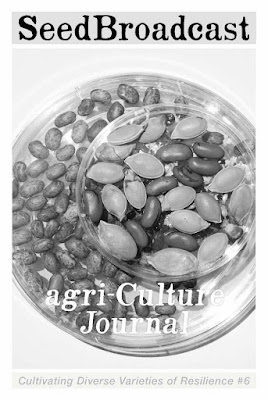
SeedBroadcast agri-Culture Journal #6


http://seedbroadcast.org/SeedBroadcast/SeedBroadcast_agriCulture_Journal_files/SeedBroadcast%20%236%202015%20WEB%20copy.pdf

The latest edition of the SeedBroadcast Journal is now available in print at various locations around New Mexico and the nation.   We will also have it available at our Mobile Seed Story Broadcasting Station and you can download it here.

Thank all of you who sent us a submission. 
You make this Journal unique and keep the seed stories alive.

Let us know what you think.


Wednesday, March 2, 2016

SeedBroadcast Report for 2015


Every year since our founding in 2011, SeedBroadcast grows bigger and digs deeper and 2015 was no exception. It was our busiest year yet. We continue to be a collaborative and creative community project working with extremely diverse partners and individuals throughout the bioregion, the continent, and the globe. We continue to function as a collective cohort whose focus is to engage agency and open-source practices in support of agri-Cultural resilience and do so through encouraging diversity and subjectivity both internally within the collective and externally in the world around us. Finally, we continue to create this work wherever the calling takes us: to gardens, farms, on the street, at museums and galleries, farmers markets, government agencies, parks, parking lots, schools, festivals, and much more. For there is no place where seeds do not inspire and transform relationships, empowerment, and radicle action as agri-Culture.

2015 was a fruitful year where we established deeper connections with familiar partners and cultivated new relationships around the region. What we noticed this year in particular is that seeds are growing in many creative and exciting ways and people are challenging themselves to establish community connections, build solidarity, and make their voices heard. Many more people are trying their hands at gardening and seed saving, the Seed Library movement is continuing to grow regardless of being threatened by industrial-ag and government regulatory commissions, and seeds are bringing together interdisciplinary collaborators, across farming, art, gardening, science, performance, health, and education.

SeedBroadcast was founded on the mission of “agri-Culture.” As one word that sums it all up, we are committed to returning the culture to agriculture and hearing the voices, honoring the hands, and germinating the life of local resilience in food, seed, and empowerment. During the last year we continued this work through our major yearly programming of the Mobile Seed Story Broadcasting Station, Seed Story Workshops, and the bi-annual agri-Culture Journal. We were also thrilled to be partners with Santa Fe Art Institute Food Justice Residency with our project |UN|silo|ED|. In 2015 we began a SeedBroadcast donation campaign with our fiscal sponsor Little Globe and located funding sources to support programming with partnering organizations and individuals. Finally we worked with Native Seed/SEARCH (NS/S) to write a Robert Rauschenberg Foundation Climate Change Solutions Fund Grant, which we were awarded in partnership with NS/S for 2015 – 2017.

SeedBroadcast at Barrio Logan Seed Bank and Chicano Art Gallery, San Diego, CA


Mobile Seed Story Broadcasting Station

In 2015, the Mobile Seed Story Broadcasting Station toured New Mexico, Colorado, and across Southern Arizona and California. During these tours we partnered with Seed Libraries, organizations hosting Seed Exchanges, schools, community garden groups, marches and festivals, and at museums and galleries. At each of these locations we had the incredible opportunity to meet people from all-over and record Seed Stories, from older rural farmers, to indigenous seed stewards, to homeless guerilla gardeners, to refugee gleaners, to young garden hipsters…. And this to name only a few. Connecting with this wide array of people concerned with open-pollinated seed and the state of local food is an incredible opportunity to redefine agri-Culture and hear in it the many voices it demands. At each event we broadcasted and recorded Seed Stories, shared seed saving resources, set up art stations for drawing, and gave away seeds. All the seeds we gifted went with a commitment, a promise that the recipients would feed their families and communities and grow/save some seeds to pass on to others.

In May 2015, we were honored to be invited to perform at the International Seed Library Forum in Tucson, AZ where we met Seed Librarians from around the globe, recorded seed stories, distributed resources, and participated in policy action against shutting down community seed libraries and seed exchanges. We were also panelists on two public forum panels, “Oral Histories and Cultural Memory-Banking Documentation for Seed Libraries,” and “Publicizing Seed Libraries and Their Missions in Your Community.”

In 2015, we recorded over 100 new Seed Stories. We broadcast these through the Mobile Seed Story Broadcasting Station and online via social media, through our blog and on our Soundcloud page. Here is a link to all of the Seed Stories recorded year-by-year: https://soundcloud.com/seedbroadcast/sets

After completing projects and participating in events we publish SeedBroadcast blogs online. Here are blog posts from each of the 2015 events:


ABC Seed Exchange, Albuquerque Public Library, Albuquerque, NM


Anton Chico Seed Exchange, Anton Chico, NM


Santa Fe Seed Exchange, Homegrown New Mexico, Santa Fe, NM


Silver City Garden Expo, Silver City Coop, Silver City, NM


Owingeh Ta Pueblos Seed Exchange, Peñasco, NM


Aztec Seed Savers and screening of Open Sesame, Aztec, NM


Bees and Seeds Festival, GMO Free New Mexico, Albuquerque, NM


Community Day, Albuquerque Museum of Art and History, Albuquerque, NM


Urban Refuge A.R.T.S., Valle de Oro, Albuquerque, NM


Sierra Farmers Market, Truth or Consequences, NM


Habitat: Exploring Climate Change through the Arts, 516 Arts, Albuquerque, NM


Celebración de Cultural Familia y Tradiciones, Peñasco, NM


Seed Keepers of the Gila, Gila, NM


Mancos Seed Exchange and Spring Hoedown, Mancos, CO


Balboa Park, City of San Diego, San Diego, CA


Patagonia Seed Library, Patagonia, AZ


Wild Willows Farm and Education Center, San Diego, CA


A Thousand Plates, San Diego State University, San Diego, CA


Barrio Logan Seed Bank, Chicano Art Gallery, San Diego, CA


International Seed Library Forum, Tucson, AZ


Ishkashitaa Refuge Network, Tucson, AZ


Seed Story Workshops

Along with MSSBS tours, we have been conducting Seed Story Workshops for several years. These involve gatherings where we screen Letter From a SeedBroadcaster (https://vimeo.com/jeanettehartmann/letter-from-a-seed-broadcaster) then circle round to talk about Seed Stories and how food, seeds, and agri-Culture are a part of each person’s life. We then have everyone spend about 10 minutes writing down thoughts and ideas after which each shares this with a partner. Everyone then returns to writing and finishing a Seed Story. Finally each person records his/her Seed Story with a partner and then assists in the recording of someone else’s story. After these initial workshops some groups head out to record Seed Stories in their neighborhoods.

This year we conducted three Seed Story workshops. One month long workshop with students from the Institute of American Indian Arts (IAIA), an evening workshop with the Aztec Seed Savers, and an informal workshop gathering with seed keepers in Gila, NM. The IAIA students worked through four sessions, at the end heading out into their communities to record one Seed Story and bring it back for final post-production editing to be included in a new Seed Library initiative at IAIA. The Seed Story Workshops with the Aztec and Gila gatherings were informal and more intimate leading to critical discussion, free form story sharing, and plans to repeat these gatherings in the future. Here is a Seed Story writing from Dan Dombrowski of Aztec, NM.

Since I started gardening about 10 years ago I enjoy watching the miracle of a tiny seed grow and produce wonderful fruits and vegetables.
My neighbors love that I share the bounty with them. I have been saving some of my seeds to preserve the most successful of the plants. Now I have begun to share seeds and add to mine with locally grown seeds that do well in our climate and soil conditions.
I enjoy producing healthy produce for my family.


SeedBroadcast agri-Culture Journal

The bi-annual SeedBroadcast agri-Culture Journal has been in print since the autumn of 2013. It is a collection of printable materials about resilient seed, food, and community health. It includes essays, poetry, photos, drawings, recipes, and more. Like all SeedBroadcast projects it is a free, open-source project that involves the creative agency of all who participate. Contributors of these materials are from around the globe and each receives a stack of journals at their doorstep to share with their community. The majority of the journals are distributed through the Mobile Seed Story Broadcasting Station, dropped off at locations around New Mexico, and additional stacks are sent to partners across the nation. All editions are also available on-line via free downloadable pdf.

Here are links to the 2015 editions:

SeedBroadcast agri-Culture Journal, Spring 2015
http://seedbroadcast.org/SeedBroadcast/SeedBroadcast_agriCulture_Journal_files/SeedBroadcast%20Spring%202015%20-%20WEB%20pages.pdf

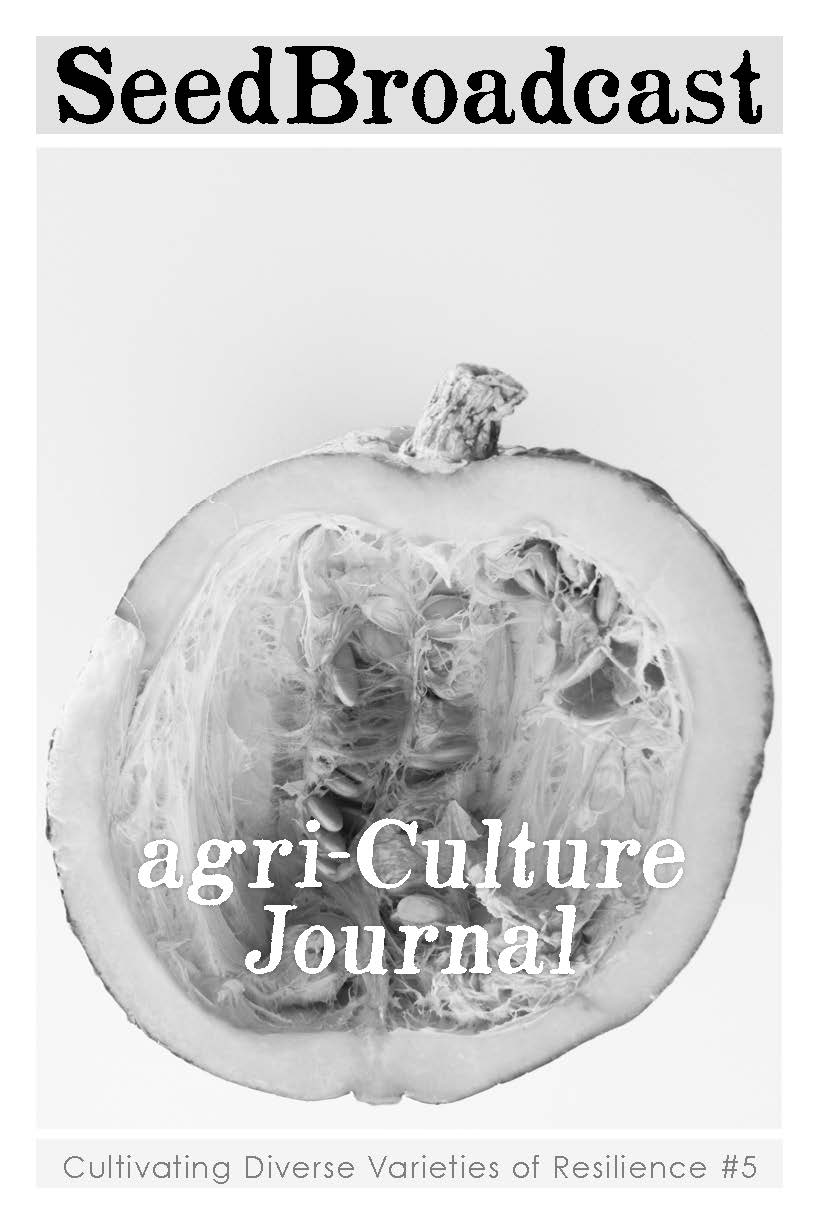
SeedBroadcast agri-Culture Journal, Cultivating Diverse Varieties of Resilience #5
http://seedbroadcast.org/SeedBroadcast/SeedBroadcast_agriCulture_Journal_files/SeedBroadcast%20Autumn%202015-WEB2_1.pdf


|UN|silo|ED|

Our partnership with Santa Fe Art Institute (SFAI) and their Food Justice Residency was the highlight of our 2015 programming bringing together residents, indigenous performance artists, UNM Art and Ecology students, Rowen White’s Seed Sevas, New Mexico farmers and gardeners, and the central New Mexico arts community to ask, “What is Food Justice” and map these answers out through a presentation of curated objects, audio soundscape, and public events. This project was titled |UN|silo|ED| and it was presented at SFAI from April 27 – June 27, 2015 in the Lumpkin Room.

During these two months of our residency, we worked both outside and inside our project space to bring together all of the Food Justice materials, record and edit Food Justice audio from interviews, and facilitate discussions and |UN|silo|ED| events. On May 16th we organized a daylong public event at SFAI, which included a seed saving workshop by Rowen White, immersive dance responses by Dancing Earth and collaborators, a pot-luck lunch of local homemade food, and an evening Seed Swap.

Then on June 20th we helped SFAI celebrate the end of their Food Justice Programming at their public Lunch@SFAI event where we presented |UN|silo|ED| and also performed with the Mobile Seed Story Broadcasting Station.

Here is the blog post from our project |UN|silo|ED|:
http://seedbroadcast.blogspot.com/2015/06/creatively-re-storying-our-seeds-at.html


Upcoming 2016 Projects

Partnership with Native Seed/SEARCH: Robert Rauschenberg Foundation Climate Change Solutions Fund Grant titled, “Capacity-Building for Climate Change Resilience in the Southwest’s Food Systems”

Finally in the spring of 2015, we worked with Native Seed/SEARCH to partner on a Robert Rauschenberg Foundation Climate Change Solutions Fund Grant titled, Capacity-Building for Climate Change Resilience in the Southwest’s Food Systems.” In early summer we received news that it was awarded to Native Seed/SEARCH as the recipient and SeedBroadcast as a co-pi/partner. With this funding SeedBroadcast will be working with Native Seed/SEARCH and farmers across New Mexico to creatively document bioregional seeds and climate appropriate agri-Culture. Through seasonal photo essays and interviews, SeedBroadcast will work with farmers to share their stories about growing food in a changing climate while cultivating eco-resiliency. These will be published via our SeedBroadcast blog. Over the next year, we hope to seek more funds for this project to publish a book.

Articles and Press

Campbell, Brian and Veteto, James. “Free seeds and food sovereignty: anthropology and grassroots agrobiodiversity conservation strategies in the US South.” The Journal of Political Ecology 22. 2015: 458-459. Online.

Esperanza, Jennifer. “Green Planet.” THE Magazine May 2015: 59. Magazine.

Fasimpaur, Karen. “Forum Sows Big Ideas About Tiny Seeds.” The Daily Yonder 10 May 2015. Online. 17 February 2016.

Kinkaid, Eden. “What is Your Seed Story? FoodTank.com. 13 June 2015. Online. 14 June 2015.

Lamberton, Ken. “Seed Saviors.” Edible Baja May/June 2015: 132. Magazine.

Roffman, Seth. “|UN|silo|ED| SeedBroadcast.” Greenfire Times June 2015: 21. Newspaper.

Shores, Elizabeth. “Art & Ecology: Exploring the Origin of Food Through Art.” Edible Santa Fe February/March 2015: 44-45. Magazine.